Telephone: +86 13313251709
Email: wxjx@vip.163.com
Address: Shanliguzhuang Industrial Park, Tongpaizhuang Township, Zunhua City, Hebei Province
Website: www.hbwxgcjx.com
In the machine manufacturing industry, the raw components produced by the weight-customized iron method are still in large quantity and heavy tonnage. The materials commonly used in the production of weight iron include metals, coke, wood, plastic, gas and liquid fuels, molding materials, etc. The required equipment includes furnaces for smelting metals, sand mixers for mixing sand, molding machines and core-making machines for molding and core-making, cleaning machines for casting parts for sand removal, shot blasting machines for cleaning, etc. There are also machines and equipment for special weight iron as well as many transportation and material handling equipment.
The production of custom-weighted iron has distinct characteristics that are different from other processes. The main features include wide adaptability, the need for a large amount of materials and equipment, and environmental pollution. The production of weighted iron generates dust, harmful gases, and noise, which cause severe environmental pollution compared to other mechanical manufacturing processes. Measures must be taken to control this pollution. The accuracy of the castings and the economic performance of the production process mainly depend on this process. In many modern weighted iron workshops, the molding and core-making have been mechanized or automated. Common sand mold-making and core-making equipment includes high-pressure, medium-pressure, and low-pressure molding machines, sand polishing machines, boxless injection molding machines, core injection machines, cold and hot core box machines, etc.
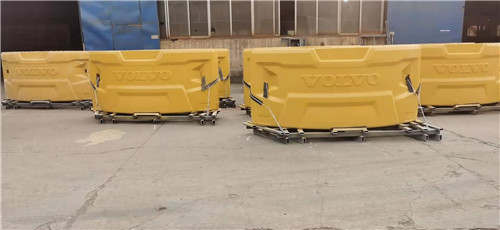
Some counterweight castings of loaders also require post-casting processing due to other requirements, such as heat treatment, rough machining, etc. The counterweight iron is a relatively economical method for blank forming, and it demonstrates its economic advantages for components with complex shapes. For example, the cylinder blocks and cylinder heads of automotive engines, ship propellers, and other artworks. For some difficult-to-machine components, such as nickel-based alloy components of steam turbines, the counterweight iron method cannot be used for forming. Additionally, the size and weight of the components of the counterweight iron have a wide range of adaptability, and the metal type is not restricted; the components not only have general mechanical properties but also have comprehensive properties such as corrosion resistance and vibration absorption, which cannot be achieved by other metal forming methods such as forging, rolling, welding, and stamping.
After the counterweight castings of the loader are removed from the self-cast cooling mold, there are gates, risers and metal burrs, and the sand mold counterweight iron castings are still adhered to the sand. Therefore, a cleaning process is required. The equipment used for this task includes shot blasting machines, gate and riser cutting machines, etc. The sand casting parting and cleaning process is a labor-intensive procedure, so when choosing the molding method, efforts should be made to create favorable conditions for the parting and cleaning process.